How many pallets fit in a 20 ft container?
Using LoadComposer's nominal 20' Dry reference, with zero modeled pallet clearance, no stacking, and rotation allowed, the planner finds 11 Euro pallet floor positions, 10 industrial pallet positions, or 10 North American pallet positions.
These are LoadComposer results for the exact inputs below, not a universal guarantee for every container or load. Pallet overhang, bulging, damaged boards, packaging, equipment tolerances, clearance, access, and the required loading sequence can reduce what is operationally usable.
Reference dimensions and settings
| LoadComposer vehicle | 20' Dry |
|---|---|
| Nominal internal dimensions | 5,896 × 2,350 × 2,393 mm |
| Nominal rear opening | 2,340 × 2,280 mm |
| Capacity settings | Rotation allowed; 0 mm modeled clearance; no stacking |
Common pallet results
| Pallet preset | Footprint | Floor positions found |
|---|---|---|
| Euro pallet | 1200 × 800 mm | 11 |
| Industrial pallet | 1200 × 1000 mm | 10 |
| North American pallet | 1219 × 1016 mm | 10 |
The orientation mix matters. For example, the 11-Euro-pallet result uses both normal and rotated footprints. LoadComposer validates the selected rectangles against its reference envelope, but the result remains an indicative geometric plan rather than a loading instruction.
Example floor layout
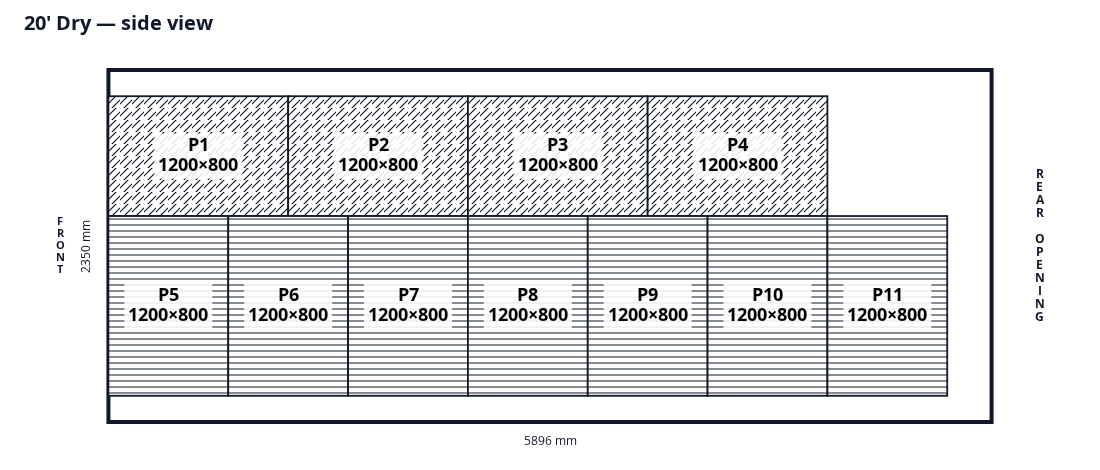
The example uses 11 Euro pallets at a loaded height of 1,500 mm. Because the requested quantity equals the floor capacity found for this scenario, the result is a regular full example rather than an awkward partial-load arrangement.
What should be checked before loading?
Measure the maximum loaded footprint and height, including overhang and packaging. Confirm the actual container's internal and door dimensions, leave the operational clearance your process requires, and separately verify weight, floor loading, securing, balance, safety, and legal constraints.