Does a 40 ft High Cube fit more pallets?
Not automatically at floor level. LoadComposer's 40' Dry and 40' High Cube references have the same modeled internal length and width, so the extra height does not automatically add floor positions. For the three common unstacked pallet footprints tested here, the current engine therefore finds the same floor capacities: 25 Euro, 22 industrial, and 20 North American pallets.
The High Cube advantage in this comparison is vertical. Its nominal internal height is 2,697 mm rather than 2,393 mm, and its nominal door height is 2,585 mm rather than 2,280 mm. That can matter for taller loaded pallets, access clearance, or a supported stacking configuration; it does not create extra floor area by itself.
40' Dry versus 40' High Cube
| LoadComposer reference | Internal L × W × H | Door W × H | Euro / Industrial / North American |
|---|---|---|---|
| 40' Dry | 12,032 × 2,350 × 2,393 mm | 2,340 × 2,280 mm | 25 / 22 / 20 |
| 40' High Cube | 12,032 × 2,350 × 2,697 mm | 2,340 × 2,585 mm | 25 / 22 / 20 |
Those capacities use rotation allowed, zero modeled clearance, no stacking, and the same pallet footprints. A different footprint, clearance, height, or stacking setting can produce a different result; actual equipment dimensions and access must always be confirmed.
What the extra height changes
LoadComposer checks loaded height against the selected vehicle reference and, where modeled, rear-opening access. If pallets are stackable, the supported layer calculation also uses vertical space, loaded height, and vertical clearance. Those checks are separate from the two-dimensional floor search.
Floor-layout example
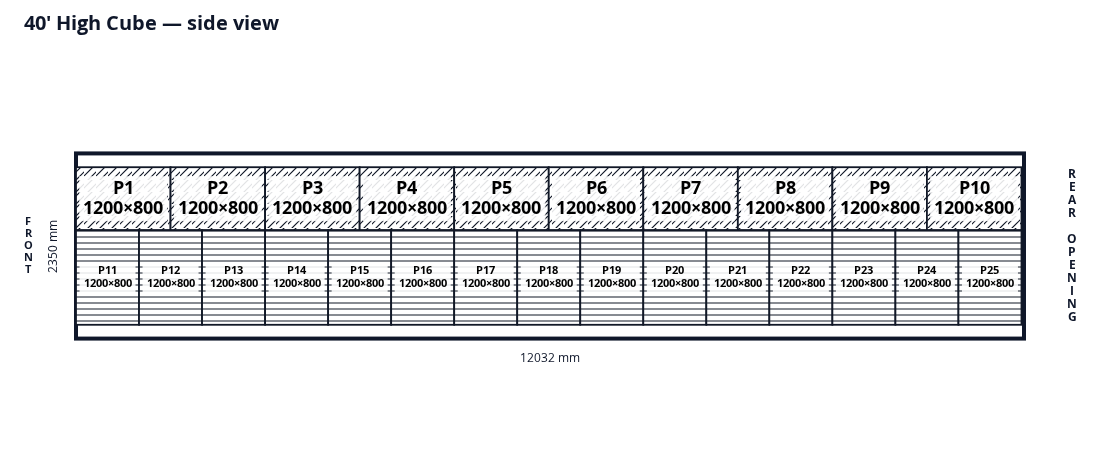
This image deliberately makes no height claim: it is the actual LoadComposer top-view floor result for 25 Euro pallets. The additional 304 mm of nominal internal height is documented in the comparison table, not inferred from a plan view.